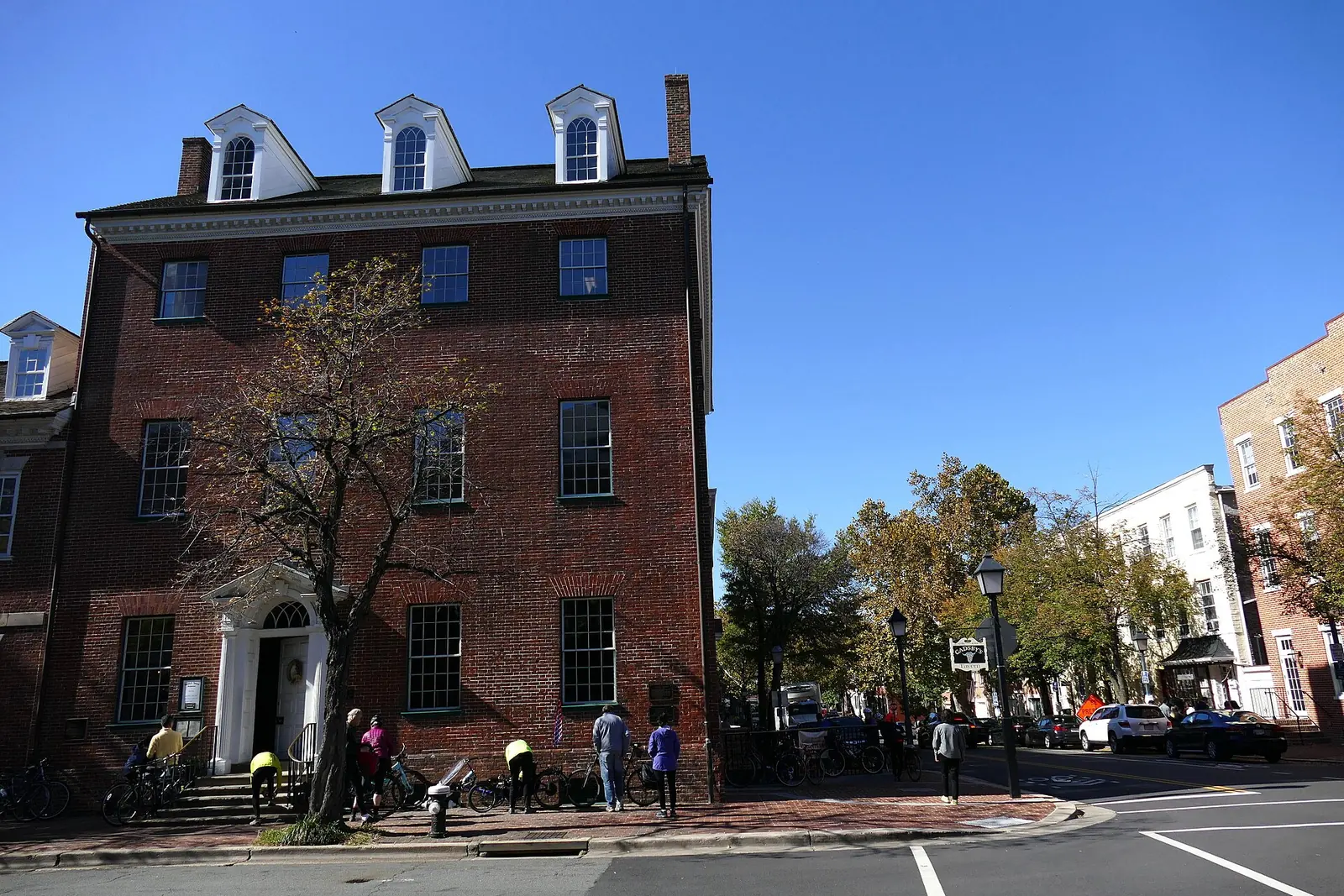
Alexandria was founded in 1749 and incorporated in 1779. It has 50 National Register listings, seven of them National Historic Landmarks, and nine city museums.
Last checked Oct. 19, 2026. Facts on this page come from the Office of Historic Alexandria’s A Brief History of Alexandria, the city’s National Register sites page and museum hours, and the National Park Service’s National Register of Historic Places listed-properties file dated May 22, 2026.
Alexandria was founded in 1749 as a tobacco port on the Potomac River and incorporated in 1779. Over the next century it became one of the 10 busiest ports in America, spent nearly half a century as part of the District of Columbia, was home to both the country’s largest slave-trading firm and a large free Black community, and became a Union supply center in the Civil War, according to the Office of Historic Alexandria.
Visit
- Office of Historic Alexandria museums: free for city residents; see hours below
- Alexandria Visitor Center: 221 King St., 703-838-5005
- Historic preservation questions: 703-746-3833, preservation@alexandriava.gov
How Alexandria began
People lived along this stretch of the Potomac long before the town. Exploring the Chesapeake Bay in 1608, John Smith met at least two groups near here, the Tauxenents and the Nacotchtanks.
On Oct. 21, 1669, Virginia’s governor granted 6,000 acres here to Robert Howson, an English ship captain. Less than a month later Howson sold the land to John Alexander for 6,000 pounds of tobacco. By 1732 Hugh West had built a tobacco warehouse on the bluffs at what is now the foot of Oronoco Street.
In the fall of 1748, Scottish and English merchants petitioned the Virginia General Assembly to found a town at West’s Hunting Creek Warehouse. In the spring of 1749 the site was chosen and named Alexandria for John Alexander. Surveyor John West laid out 60 acres, by tradition with help from 17-year-old George Washington, and the lots were auctioned in July 1749.
Key dates
| Year | What happened |
|---|---|
| 1749 | Town founded and lots auctioned |
| 1755 | British Gen. Braddock makes Carlyle House his headquarters in the French and Indian War |
| 1779 | Alexandria incorporated |
| 1789 | Virginia cedes Alexandria to the new District of Columbia |
| 1801 | Congress formally accepts it |
| 1847 | Alexandria returned to Virginia |
| May 24, 1861 | Union troops occupy the city, which becomes a federal supply center |
| 1863-65 | Capital of the Restored Government of Virginia |
| 1871 | Current City Hall built on the 1752 Market Square site |
The historic districts
Six Alexandria historic districts are on the National Register. The Alexandria Historic District, the Old and Historic District, holds about 200 early buildings in an area bounded roughly by the Potomac, Franklin, Washington and Queen streets; it was listed in 1966. The others are Town of Potomac (Del Ray and St. Elmo, 1992), Rosemont (1992), Parkfairfax (1999), Uptown-Parker-Gray (2010) and Fairlington, the World War II defense housing at King Street and South Quaker Lane, which the city also counts. Changes to buildings in the local Old and Historic Alexandria and Parker-Gray districts need city approval; see our permits guide.
National Register listings
The National Park Service lists 50 Alexandria properties on the National Register of Historic Places. Seven are also National Historic Landmarks (marked NHL).
| Listed | Property | Address |
|---|---|---|
| 1966 | Gadsby’s Tavern (NHL) | 128 N. Royal St. |
| 1966 | Alexandria Historic District (NHL) | Old Town |
| 1969 | The Lyceum | 201 S. Washington St. |
| 1969 | Carlyle House | 121 N. Fairfax St. |
| 1970 | Christ Church (NHL) | Cameron and Columbus streets |
| 1973 | Bank of Alexandria | 133 N. Fairfax St. |
| 1976 | Lloyd House | 220 N. Washington St. |
| 1978 | Franklin and Armfield Office (NHL) | 1315 Duke St. |
| 1979 | Lee-Fendall House | 614 Oronoco St. |
| 1980 | Alexandria Canal Tide Lock | Canal Center Plaza |
| 1980 | Old Dominion Bank Building | 201 Prince St. |
| 1980 | Jones Point Lighthouse and District of Columbia South Cornerstone | Jones Point Park |
| 1980 | Protestant Episcopal Theological Seminary | 3737 Seminary Road |
| 1981 | Mount Vernon Memorial Highway | Washington Street and George Washington Memorial Parkway |
| 1982 | Fort Ward | 4301 W. Braddock Road |
| 1982 | Stabler-Leadbeater Apothecary Shop (NHL 2021) | 105-107 S. Fairfax St. |
| 1984 | Alexandria City Hall | 301 King St. |
| 1985 | St. Paul’s Episcopal Church | 228 S. Pitt St. |
| 1985 | President Gerald R. Ford Jr. House (NHL) | 514 Crown View Drive (private home) |
| 1986 | Robert E. Lee Boyhood Home | 607 Oronoco St. |
| 1986 | Bayne-Fowle House | 811 Prince St. |
| 1991 | Fairfax-Moore House | 207 Prince St. |
| 1991 | Southwest No. 1, No. 2 and No. 3 boundary markers of the original District of Columbia | 1220 Wilkes St.; Russell Road north of King Street; 2952 King St. |
| 1992 | Town of Potomac Historic District | Del Ray |
| 1992 | Rosemont Historic District | Rosemont |
| 1995 | Alexandria National Cemetery | 1450 Wilkes St. |
| 1999 | Parkfairfax Historic District | Parkfairfax |
| 2000 | Bruin’s Slave Jail | 1707 Duke St. |
| 2001 | Old Presbyterian Meeting House | 321 S. Fairfax St. |
| 2003 | Orange and Alexandria Railroad Hooff’s Run Bridge | Jamieson Avenue at Hooff’s Run |
| 2004 | Alfred Street Baptist Church | 313 S. Alfred St. |
| 2004 | Beulah Baptist Church | 320 S. Washington St. |
| 2004 | Davis Chapel | 606-A S. Washington St. |
| 2004 | Moses Hepburn Rowhouses | 206-212 N. Pitt St. |
| 2004 | Dr. Albert Johnson House | 814 Duke St. |
| 2004 | Odd Fellows Hall | 411 S. Columbus St. |
| 2004 | George Lewis Seaton House | 404 S. Royal St. |
| 2010 | Uptown-Parker-Gray Historic District | Parker-Gray |
| 2012 | Contrabands and Freedmen Cemetery | 1001 S. Washington St. |
| 2013 | Alexandria Union Station | 110 Callahan Drive |
| 2013 | Charles M. Goodman House | 510 N. Quaker Lane |
| 2015 | George Washington Masonic National Memorial (NHL) | 101 Callahan Drive |
| 2017 | Appomattox Statue | Prince and Washington streets |
| 2018 | Oakland Baptist Cemetery | 4195 W. Braddock Road |
| 2019 | Swann-Daingerfield House | 712 Prince St. |
| 2021 | George Washington High School | 1005 Mount Vernon Ave. |
| 2025 | Bank of Potomac, Executive Office and Governor’s Residence of the Restored Government of Virginia | 413-415 1/2 Prince St. |
| 2025 | Ivy Hill Cemetery | 2823 King St. |
Years are the National Register listing year from the Park Service file; the three boundary markers are separate listings. Most are private property or working churches; look from the street unless the site is open to visitors.
Museums you can visit
City residents get free admission to all city-run museums. Hours are as the city publishes them.
| Museum | Address | Phone | Hours | Admission |
|---|---|---|---|---|
| Gadsby’s Tavern Museum | 134 N. Royal St. | 703-746-4242 | Through Oct. 31: Thursday-Friday 11 a.m.-4 p.m., Saturday 11 a.m.-5 p.m., Sunday-Tuesday 1-5 p.m. | $5 adults, $3 ages 5-12 |
| Stabler-Leadbeater Apothecary Museum | 105-107 S. Fairfax St. | 703-746-3852 | August-October: Wednesday-Friday 11 a.m.-4 p.m., Saturday 11 a.m.-5 p.m., Sunday-Monday 1-5 p.m. | $5 adults, $3 ages 5-12 |
| Alexandria History Museum at the Lyceum | 201 S. Washington St. | 703-746-4994 | Thursday-Friday 11 a.m.-4 p.m., Saturday 11 a.m.-5 p.m., Sunday 1-5 p.m. | $3 |
| Fort Ward Museum and Historic Site | 4301 W. Braddock Road | 703-746-4848 | Same as the Lyceum; park open sunrise to sunset | $3 |
| Freedom House Museum | 1315 Duke St. | 703-746-4702 | Same as the Lyceum | $5 adults, $3 ages 5-12 |
| Alexandria Black History Museum | 902 Wythe St. | 703-746-4356 | Same as the Lyceum | $3 |
| Alexandria Archaeology Museum | Torpedo Factory Art Center, 105 N. Union St., unit 327 | 703-746-4399 | Tuesday-Friday 11 a.m.-4 p.m., Saturday 11 a.m.-5 p.m., Sunday 1-5 p.m. | Free |
| Friendship Firehouse Museum | 107 S. Alfred St. | 703-746-3891 | One Saturday a month | $3 |
Freedom House Museum is in the Franklin and Armfield Office building at 1315 Duke St., a National Historic Landmark.
Cemeteries, memorials and markers
- Contrabands and Freedmen Cemetery Memorial, 1001 S. Washington St., open dawn to dusk. About 1,800 African Americans who fled slavery to Alexandria during the Civil War were buried here; the memorial honors them.
- African American Heritage Park, open dawn to dusk, with a 19th-century African American cemetery and the bronze sculpture “Truths That Rise From the Roots Remembered.”
- Alexandria National Cemetery, 1450 Wilkes St., and Ivy Hill Cemetery, 2823 King St., are both on the National Register.
- Alexandria Union Station, built in 1905, is still an Amtrak station with interpretive exhibits.
- Heritage Trail markers and self-guided tours are mapped on the city’s Plan Your Visit page.
What this means for you
- Live in the city? Bring proof of residency for free museum admission.
- Gadsby’s Tavern changes to winter hours after Oct. 31; check before you go.
- Owners in the historic districts need approval before exterior work.
Related guides: things to do this month, parks and trails in Alexandria and Alexandria population and growth.
Frequently asked questions
When was Alexandria, Virginia, founded?
In 1749. Merchants petitioned the Virginia General Assembly in the fall of 1748, the site at West’s Hunting Creek Warehouse was chosen in the spring of 1749 and lots were auctioned in July 1749. The town was incorporated in 1779.
Who is Alexandria, Virginia, named after?
John Alexander, a Scotsman who owned much of the land. He bought the 6,000-acre Howson grant in 1669 for 6,000 pounds of tobacco, the city says.
Was Alexandria ever part of Washington, D.C.?
Yes. Virginia ceded Alexandria to the new District of Columbia in 1789, Congress formally accepted it in 1801, and it was returned to Virginia in 1847.
How many National Register sites are in Alexandria?
The National Park Service lists 50 Alexandria properties on the National Register of Historic Places, from Gadsby’s Tavern (1966) to Ivy Hill Cemetery (2025).
Are Alexandria’s city museums free?
For city residents, yes: residents get free admission to all city-run museums. Others pay $3 to $5, and the Archaeology Museum is free for everyone.
Have your say